

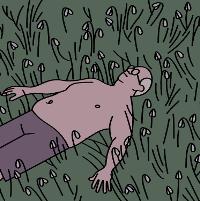
Just in case you missed it, I feel it is my public duty to draw your attention to the news that a seven-minute film from Ireland, Retirement Plan, has been nominated for an Oscar this spring in the Best Animated Short Film category. The piece, directed by Royal College of Art graduate John Kelly with a voiceover by Domhnall Gleeson, is wistful and poignant – and well worth viewing. In the film, a man called Ray describes all the glorious, productive and crazy things he is going to do when he retires (on a scale from replying to every email he’s ever flagged to paragliding) before being confronted with his own impending mortality.
What makes the recognition of Kelly’s animated film by the 2026 Academy Awards so unusual is the subject. Speculating in such a singular fashion on your retirement is not necessarily the normal Hollywood fare, although plenty of mainstream films touch on aspects of the subject (Bill Nighy’s performance in Living (2022) and the ensemble playing in The Best Exotic Marigold Hotel (2011) both deserve a mention.)
More generally, it could be argued that the challenges of older age are given insufficient creative attention. So, when a would-be retiree appears on the red carpet (even a hand-drawn one), it’s a moment to celebrate. Will we see growing artistic focus on the ambitions and obstacles of retirement as a result of this Oscar nomination? That is hard to say, but sections of the design community have been paying growing attention to finding ways to devise a healthier and more fulfilling later life for a long time now– and attitudes around designing for retirement have already shifted considerably.
This year marks 40 years since the Victoria & Albert Museum staged its landmark exhibition, New Design for Old, in its Boilerhouse gallery. The 1986 show, curated by Helen Hamlyn and Elizabeth Henderson, commissioned 15 leading international designers to rethink everyday objects for the home to allow older people to continue to live independently without having to go into residential care.
Many of the innovations produced for the exhibition were groundbreaking at the time: the TV set that swivels so you can watch lying down; the shower that incorporates a chair so you can sit down while bathing; the light switch that glows at the edges so you can locate the switch when the light is switched off. However, the overriding focus around retirement back then was on safety, support and confinement to the home.
When I was asked by the Design Museum to revisit New Design for Old 30 years later, the landscape of design for ageing had changed remarkably. In updating the show with new exhibits and commissions in 2017, I learnt that the action was no longer just inside the home, as new sections on identity, mobility, work and community demonstrated. The potential of robotics, AI and driverless cars was on the horizon. The design frame around full or partial or no retirement was much larger. The ambition was much more all-inclusive and encompassing, rather than simply to avoid accidents in the bathroom or enable comfortable viewing of daytime television.
Today, as more of us head into the grey and ill-defined hinterland of ‘retirement’ with a set of aspirations like Ray’s to-do list in Retirement Plan, there’s more opportunity – and uncertainty – than ever before. Ray says in the film, ‘I will be so present, so aggressively present.’ Let’s hope the film of his hopes and dreams wins that Oscar.
About the Author
Jeremy Myerson is Professor Emeritus in the Helen Hamlyn Centre for Design, Royal College of Art, and an Honorary Professorial Fellow at the Oxford Institute of Population Ageing.
Opinions of the blogger is their own and not endorsed by the Institute
Comments Welcome: We welcome your comments on this or any of the Institute's blog posts. Please feel free to email comments to be posted on your behalf to administrator@ageing.ox.ac.uk or use the Disqus facility linked below.
_square_xs.jpg)


_square_xs.jpg)