

Researchers routinely invest enormous amounts of time and effort in trying to figure out the future of products and services for the societies of tomorrow. Whether they’re engaged in scenario planning, design thinking, envisioning, imagineering or forecasting, running workshops, conducting vox pops, or documenting lives, the aim of this work is to give us a sense of what’s coming next.
We’re all implicated in this activity, eagerly devouring the many reports, films, scenarios, models, TED talks, policy statements and prototypes that futures research produces. This is especially true when it comes to considering design for an ageing population. But what if many of these future visions are missing the mark, or worse, creating a false picture? What if inherent bias, lazy thinking or faulty processes could be undermining what futures work is trying to achieve?
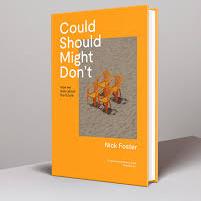
These questions are central to an engaging and provocative new book called Could Should Might Don’t: How we think about the future, written by Nick Foster, a self-styled ‘futures designer’ based in Silicon Valley. The author has worked on futures projects for Sony, Apple, Google, Dyson and Nokia, but is now sounding the alarm about the efficacy of such work. His book maps out four alternative ways of framing the future – each with their own possibilities and pitfalls.
Could futurism is the most optimistic, uncritical and naively gung-ho of the quartet. Dazzled by technological possibility, this type of futurism is driven largely by sci-fi literature and movies. A world of flying cars, cybernetic robots, gene therapy drugs and gleaming neon skylines gets everyone excited and is the dominant way to think about the future. But it’s also derivative and repetitive, and not nearly as imaginative as we think it is, according to Nick Foster.
Should futurism takes a different stance. Driven by ideology or values, it points with certainty at what the world ‘should’ be like and builds its case carefully with data and analytics. Much corporate strategy can be found in this camp. Should futurists lean heavily on the language of ‘better’ yet struggle to defines what better means.
Might futurism deals in probabilities rather than certainties, assigning a probability to a range of different scenarios. This is the world of scenario planning, strategic forecasting, game theory and decision trees where multiple perspectives are held in balance and discussed in detail. It’s a serious and thoughtful approach but it can also lead to indecision and paralysis.
The final model of futurism is perhaps the most powerful. This is Don’t futurism, which is driven by fear and partly rooted in religious beliefs about hell and purgatory. By exploring unintended consequences, negative impacts, dystopian scenarios and existential threats, the cautionary tales of Don’t futurism warn us where not to go. Looking hard at the downsides can be important and instructive, says Foster, but also crippling in terms of moving forward. The rise of Don’t futurism explains why young people are now less optimistic about the future than at any time in our recent history.
If we map the four models of future thinking onto the challenge of designing for an ageing population, we can begin to see the differences between them – and the problems that concentrating on only one might produce. Could futurists will evangelise about robots caring for older people, or driverless vehicles collecting them at their door to go to the shops. But research consistently suggests that what older people want the most is to connect with another human being.
Should futurists will decide what is ‘better’ for older people and find the evidence to support their ideology. That could lead to a benign and supportive society acknowledging the challenges of ageing and redesigning the environment accordingly – or it could lead to involuntary euthanasia as government policy.
Might futurists will wargame the scale of probability of different courses of action to the point at which nothing positive gets done. And Don’t futurists will uncover the dark side of ageing to the extent that policymakers conclude that older people are a terrible burden on society and any investment in their needs is pointless.
Nick Foster argues that we need all four types of futurism, as described in his book, to achieve a more rigorous and balanced approach. He says ‘the future is accretive’ – it builds on the present just as the present has built on the past – and talks about ‘the future mundane’ which is ordinary, everyday and boring. This is far away from the unconstrained tech speculation of Could futurism and is something to consider the next time we received some new research or visual communication speculating about what a future ageing society might look like.
Could Should Might Don’t: How we think about the future, Nick Foster (Canongate 2025)
About the Author
Jeremy Myerson is Professor Emeritus in the Helen Hamlyn Centre for Design, Royal College of Art, and an Honorary Professorial Fellow at the Oxford Institute of Population Ageing.
Opinions of the blogger is their own and not endorsed by the Institute
Comments Welcome: We welcome your comments on this or any of the Institute's blog posts. Please feel free to email comments to be posted on your behalf to administrator@ageing.ox.ac.uk or use the Disqus facility linked below.

_square_xs.jpg)


_square_xs.jpg)