

Have you noticed how professionals in every discipline associated with healthy ageing are always convinced that their own branch of expertise will be the one that makes all the difference?
Clinicians believe that clinical practice will be the key factor in successful interventions. Architects point to the neighbourhood plan or the building structure as proof of progress. Ethnographers claim that discovering hidden behavioural insights will move the dial. Data scientists say the answer lies deep in the numbers. Occupational therapists put a premium on patient care. Communication designers think the medium is the message. Transport planners hold up active travel as the way forward. And so on.
So I found it refreshing this autumn to come across a healthy ageing project in the Netherlands unconcerned with discipline boundaries and eager to advance a more integrated approach for the many different branches of professional expertise needed to improve older lives.
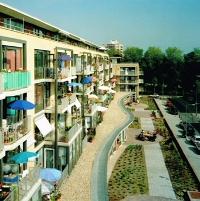
Femke Feenstra is an architect. But her work on a Dutch government challenge project to rethink residential care for older citizens was not an architectural contribution in the formal sense. Feenstra joined a large, all-female, multidisciplinary team spanning design, landscape, care, research, medicine and education to breathe new life into a problematic housing block called Beresteinlaan for 60 people in The Hague - a long, thin, unsafe, badly maintained building surrounded by busy roads.
Speaking at the Healthy City Design Congress 2026, where she won best paper for her presentation, Feenstra explained how Dutch government policy is now to support ageing well in your own home, clustered housing, and nursing homes – but not care homes. The team working on the Beresteinlaan estate was mindful of this gap. How could it support health over the longer term for residents aged from 55 upwards and living independently in this clustered block?
The answer was to climb out of established disciplinary silos and think holistically about the challenge. Yes, there was some architectural stuff to fix a troublesome built environment by animating the ground floor with mini gardens and meeting spaces, creating new routes through the building, and rerouting traffic away from the site.
But this was only part of a project which had a governing premise to connect people and space, people and care organisations, and people with each other. Through creative codesign, a ‘back and forth’ process was developed to match needs and resources among the residents. This was reinforced by a simple digital platform where people could offer to cook for a neighbour or take in a parcel.
The emphasis was on changing mindsets, not just on changing the environment. Femke Feenstra describes the innovative Beresteinlaan pathfinder as ‘a method, not a design’ – that’s how far the professionals on this healthy ageing project climbed out of their bunkers.
Multidisciplinary working of this type isn’t easy. (Did an all-woman lineup of professionals make it easier?) I am also aware of a comment made by Italian design academic Ezio Manzini that ‘you can’t have multi-disciplinarity without having strong disciplines.’ But as we grapple with the multi-faceted problem of healthy ageing in place – a task which sometimes resembles three-dimensional chess – it is worth remembering that clinging tenaciously to the credentials of your chosen discipline isn’t always the best way to go.
About the Author
Jeremy Myerson is Professor Emeritus in the Helen Hamlyn Centre for Design, Royal College of Art, an Honorary Professorial Fellow at the Oxford Institute of Population Ageing, and Academic Director of the Healthy City Design Congress.
Opinions of the blogger is their own and not endorsed by the Institute
Comments Welcome: We welcome your comments on this or any of the Institute's blog posts. Please feel free to email comments to be posted on your behalf to administrator@ageing.ox.ac.uk or use the Disqus facility linked below.