

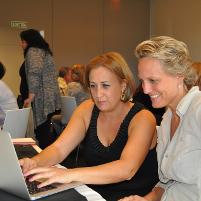
Imagine entering a technology class and being told that the younger students expect you to struggle; or, instead, that they are pleased to see you there. Could that message affect your decision to stay?
Technology is woven into everyday life, from booking medical appointments and managing money to maintaining relationships and improving safety at home. Digital skills can support independence, but access and ability are only part of the picture. Previous research has established the importance of confidence and perceived ability in technology adoption (Czaja et al., 2006). Our experimental study examines a less explored influence: social norms, or the shared expectations that guide how people believe members of a group should behave (Legros & Cislaghi, 2020), and whether they affect older adults’ willingness to learn (Focacci et al., 2026).
We surveyed 320 UK residents aged 70 and over. Participants imagined being invited to an intergenerational technology class covering social media, voice assistants and home-safety devices. The scenario offered different ability levels and topics, reflecting evidence that older learners value choice, relevance and control over how much they learn (Duay & Bryan, 2008). One group was told that younger students considered it normal for older people to embrace technology. Another received a discouraging message, while a control group received no information about other students’ expectations.
The adjusted statistical results provide the clearest evidence. After accounting for education, health and motivations connected with technological confidence, exposure to the positive message produced a 0.57 increase in the ordered log-odds of choosing a more complete learning experience (p<.05). This is an odds ratio of approximately 1.77: participants receiving the positive message had about 77% higher proportional odds of choosing a higher participation category than the control group.
The descriptive figures help illustrate that result. Some 56.6% of the positive-message group chose the shared classroom, compared with 44.9% of the control group. Although only 33.6% of the negative-message group selected the shared class, the negative treatment did not have a statistically significant independent effect after the other variables were considered. The evidence therefore supports the benefit of encouragement more clearly than the harm of one discouraging message.
A philosophical perspective on ageing, agency and technology
Some reluctance to learn new technologies in later life may reflect the disruption of established routines rather than an inability to learn. Older people may have developed ways of working, communicating and maintaining independence in a different technological world. A new device can ask them to change more than a practical skill: it can also impose unfamiliar ideas about what counts as efficient or convenient. Simion and Kelp’s (2026) work on conceptual engineering offers a useful way to think about this: changes in the concepts people use can have ethical and social consequences. Applied to digital learning, this suggests that hesitation may express a considered attachment to valued ways of life, rather than incapacity (Simion & Kelp, 2026).
A single encouraging message is only part of the story. Older adults who had come to see themselves as less independent or adaptable were less willing to join the class. Negative stereotypes can become self-reinforcing: anxiety about appearing “too old for technology” may itself weaken confidence and discourage people from trying (Mariano et al., 2022).
The analysis also showed that the positive message was less effective among participants who already felt undervalued or disrespected. A welcoming message can help, but it may not undo experiences of exclusion accumulated over time.
The study has limitations. Most respondents completed the survey online and therefore already possessed some digital ability. It also measured intentions within a hypothetical scenario rather than long-term behaviour. Nevertheless, it offers a practical lesson: digital-inclusion programmes should do more than teach buttons and menus. They should create respectful, shame-sensitive spaces in which learners can practise and make mistakes (Walker, 2017), communicate that older learners belong and recognise that choosing not to adopt a technology can also be legitimate.
This approach reflects World Health Organization guidance identifying education and intergenerational contact as effective strategies against ageism. UNESCO similarly argues that well-designed digital learning can strengthen older people’s participation. Inclusion, however, should not make one digital lifestyle compulsory. It should combine a genuine invitation to learn with respect for the routines, values and choices through which people already live.
References
- Czaja, S. J., Charness, N., Fisk, A. D., Hertzog, C., Nair, S. N., Rogers, W. A., & Sharit, J. (2006). “Factors predicting the use of technology: Findings from the Center for Research and Education on Aging and Technology Enhancement (CREATE).” Psychology and Aging, 21(2), 333–352.
- Duay, D. L., & Bryan, V. C. (2008). “Learning in later life: What seniors want in a learning experience.” Educational Gerontology, 34(12), 1070–1086.
- Focacci, C. N. Mascini, P., Lam, P. H., Darity, W. (2026). “Social Norms and Technology Engagement in Later Life: An Experimental Study.” Educational Gerontology.
- Legros, S., & Cislaghi, B. (2020). “Mapping the social-norms literature: An overview of reviews.” Perspectives on Psychological Science, 15(1), 62–80.
- Mariano, J. et al. (2022). “Too old for technology? Stereotype threat and technology use by older adults.” Behaviour & Information Technology, 41(7), 1503–1514.
- Simion, M., and Kelp, C. (2026). Knowledge and Conceptual Engineering: The Epistemology, Ethics, and Politics of Meaning Production. Oxford University Press.
- UNESCO (2021). “Digital Literacy for Older Persons.”
- Walker, J. (2017). “Shame and transformation in the theory and practice of adult learning and education.” Journal of Transformative Education, 15(4), 357–374.
- World Health Organization (2021). Global Report on Ageism
About the Author
Dr Chiara Natalie Focacci is a Research Fellow at the Oxford Institute of Population Ageing.
Opinions of the blogger is their own and not endorsed by the Institute
Comments Welcome: We welcome your comments on this or any of the Institute's blog posts. Please feel free to email comments to be posted on your behalf to administrator@ageing.ox.ac.uk or use the Disqus facility linked below.